
Blog /
Scale Analysis Before You Scale the Lakehouse
Harsh Vardhan Goswami
On this page
A lot of 2026 data-engineering writing is about keeping a lakehouse alive: snapshot expiration, compaction, manifest rewrites, catalogs that choke at thousands of tables. That work is real for the companies that have that estate. It is a distraction for a startup whose pain is “we cannot agree what revenue is” or “the analyst’s SQL lives in a screenshot.”
Object-store janitors will not save a meeting where two people mean different grains. They will consume the only engineer who could have written the metric card.
Leave with a sequence ordered by headcount, and a diagnostic that tells you whether you have a lake problem or a clarity problem. Most growing teams have the second and buy tools for the first because the first has better blogs.
A week in the wrong queue
Monday: dashboard disagrees with finance by 8%. Tuesday: someone files “we need a warehouse.” Wednesday: three vendor calls. Thursday: still no owner for net revenue. Friday: the 8% is a timezone. You now have a Slack thread named “lakehouse” and the same unsigned metric.
That week is the product of reading infrastructure essays while the company is still in the argument stage. Iceberg maintenance at 10,000 tables is a real job. You are not there. Pretending you are there is how the only senior engineer spends Q4 on compaction policy.
If a vendor asks “how many tables,” and the honest answer is “enough that we fight about five numbers,” you are shopping for the wrong layer.
What “data scaling” actually is at SMB size
Before Iceberg maintenance, teams hit simpler ceilings:
- One Postgres instance answering OLTP and a growing report set, until writes jitter.
- The same metric in three dashboards, none of them signed.
- An intern or an agent querying production without row caps.
- CSV exports as the integration layer, emailed weekly, overwritten silently.
Those are analysis and governance problems. A new table format does not fix them. It adds a second career: someone must run compaction, or the lake becomes the slow, expensive version of the CSV folder.
A data lake is a fit when you have heterogeneous landing data and a team to operate the layers. It is not the default upgrade from “our app database got bigger.”
Diagnostic: lake problem or clarity problem?
Answer these. Be unkind.
| Question | If yes | If no |
|---|---|---|
| Can you name owners for the five numbers leadership asks weekly? | You might be ready to scale engines | You have a semantic problem. Stop. |
| Do exploratory scans land on a replica or extract, not the primary? | Good | You have a load problem that a lake will copy, not fix |
| Can a second person rerun last week’s investigation without Slack archaeology? | You are scaling analysis | You have a log problem. Notebooks before catalogs |
| Are you waiting on file compaction to explain a 12% dashboard move? | Unlikely | You are reading the wrong blogs |
| Do multiple engines already share the same large files? | Lakehouse operations may be due | Do not introduce a third engine “for scale” |
If the left column is mostly empty, buying lakehouse ops content is how you stay busy and still lose the meeting.
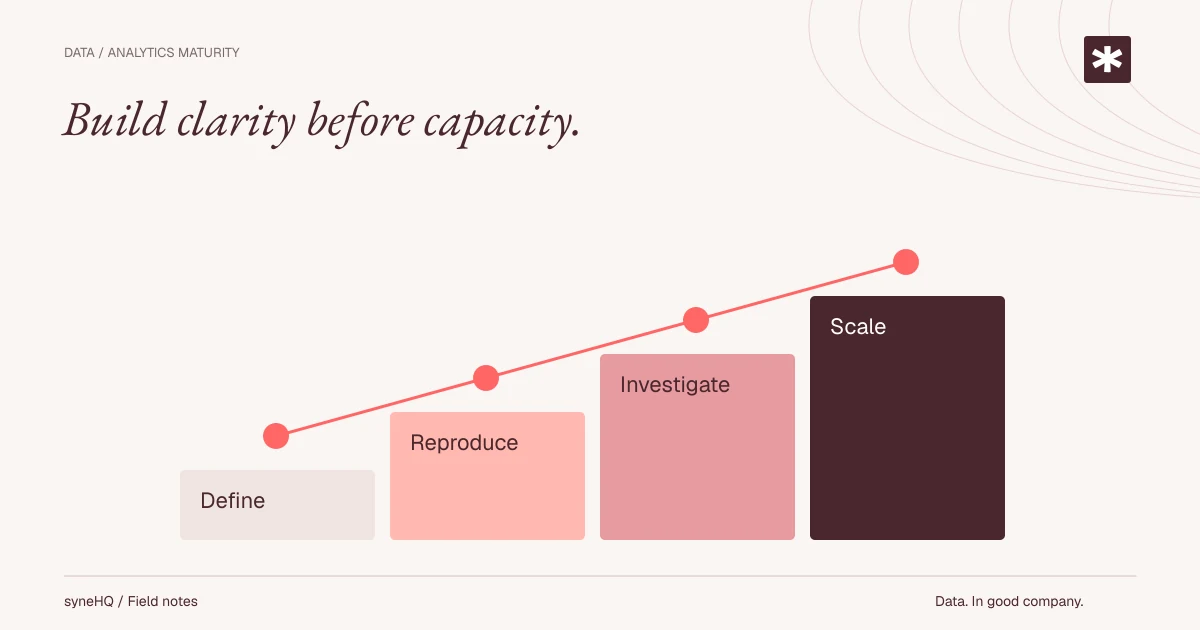
A sequence that respects headcount
- Define the five metrics and where they are queried. Cards, not vibes.
- Separate exploratory reads from production writes. Read replicas, roles, approvals, statement timeouts.
- Make investigations reproducible. Notebook or saved query, not a slide export.
- Move heavy scans off the primary when they hurt latency: replica, warehouse extract, or an analytical engine for the question of the day—not a full lake program.
- Adopt a lakehouse when multiple engines share the same large files and you can name the person who will run maintenance on a Tuesday.
Skipping to step 5 because a blog said “10 tables is config, 10,000 is infrastructure” is how a five-person data function spends a quarter on compaction policy while revenue still has two definitions.
Federation is often enough
Many SMB questions span app Postgres, a Stripe export, and a product event table. Federation or a scheduled extract into one analysis connection can be enough. You are scaling the analyst’s loop, not Netflix’s catalog.
If a query is slow, measure it. EXPLAIN, indexes, materialized views, and “do not scan events for a KPI” beat a format migration that nobody operates. Slow-query log first. Architecture Twitter second.
Agents make premature lakes more expensive
Agents multiply queries. Pointing an agent at a half-maintained lake produces more small files and more confused joins. Pointing it at a curated replica with definitions and caps produces more answers you can defend. Volume belongs on a bounded dataset. See agents do not query like people.
A lake without a card is a larger place to be wrong.
Product shape for the middle of the sequence
SyneHQ’s bet is steps 1–4: Data Explorer for records and schema, Dashboards for known questions, Quantum Lab for investigations, database tools for the operational last mile. None of that requires Iceberg maintenance. If you already have a lake, connect it and keep the same review rules.
You can do steps 1–4 with Postgres, a replica, and markdown. The product question is whether the definition, the query, the notebook, and the approval live in four vendors or in one workspace a teammate can open.
Take this home: scale clarity, then engines, then janitors. If you postponed a lake project after this diagnostic, that is a successful reading. If you want the middle of the sequence in one governed workspace, that is the product. The lake can wait until you can name who runs it.
Put it to work
Bring the next question into your workflow.
Keep the query, result, and explanation together when the analysis becomes team work.