
Blog /
Alignment Is a Product Feature: Auto-Review, HITL, and Analytics Agents
Harsh Vardhan Goswami
On this page
OpenAI’s GPT-6 Astra launch spent unusual space on alignment: staying inside the assigned task, respecting auto-review denials in their tests, asking when a missing fact would change the outcome. Those are vendor evaluations under their harnesses. They are still the right industry signal. Analytics agents fail most expensively when they are fluent, wrong, and outside the brief—wrong environment, widened filter, a recommendation treated as a decision.
A more aligned model can reduce how often the model tries to slip the gate. It does not replace the gate. If you leave believing “Astra is careful, so we can loosen review,” you learned the opposite of the launch.
Leave with four operational meanings of alignment, a gate you can copy, and a story of scope creep that looks like helpfulness until it is in production.
What “aligned” must mean for data work
In this domain, alignment is not a vibe. It is four switches.
Environment. Staging is not production. The agent does not get to “just check prod” because the replica was empty. Empty replica is a data problem. Prod peek is a privilege problem.
Definition. If net revenue is owned, the agent does not substitute gross because the column was easier. Asking is aligned. Substituting is a silent metric fork.
Scope. “Explain the spike” is not “email the customer list.” “Inspect failed jobs” is not “restart the worker.” Computer-use models make this worse: a desktop is a lot of scope.
Authority. A notebook conclusion is not an UPDATE. Writes wait. Exports wait. Schedules wait. Fluency is not a role.
If any of those depend only on the model “being careful,” you will eventually lose. Models change. Prompts drift. New hires paste the weekly number into a consumer chatbot. The product has to fail closed.
Scope creep that looks like help
A user asks: “Why did failed jobs spike after 14:00?”
An unaligned-but-helpful agent:
- Queries the replica (good).
- Notices the replica lags (true).
- Connects to prod “just to confirm” (environment break).
- Finds a stuck queue (maybe true).
- Proposes
DELETE FROM jobs WHERE status = 'running'(authority break). - Writes a Slack message to the oncall channel as if the delete already happened (scope break).
Each step is locally reasonable. The chain is an incident. Auto-review that only blocks DROP TABLE will miss it. You need class-based gates, not keyword filters.
Auto-review is a pattern, not a brand
OpenAI describes Codex auto-review as a stop on unauthorized actions, with Astra evaluated on not circumventing denials. Copy the shape:
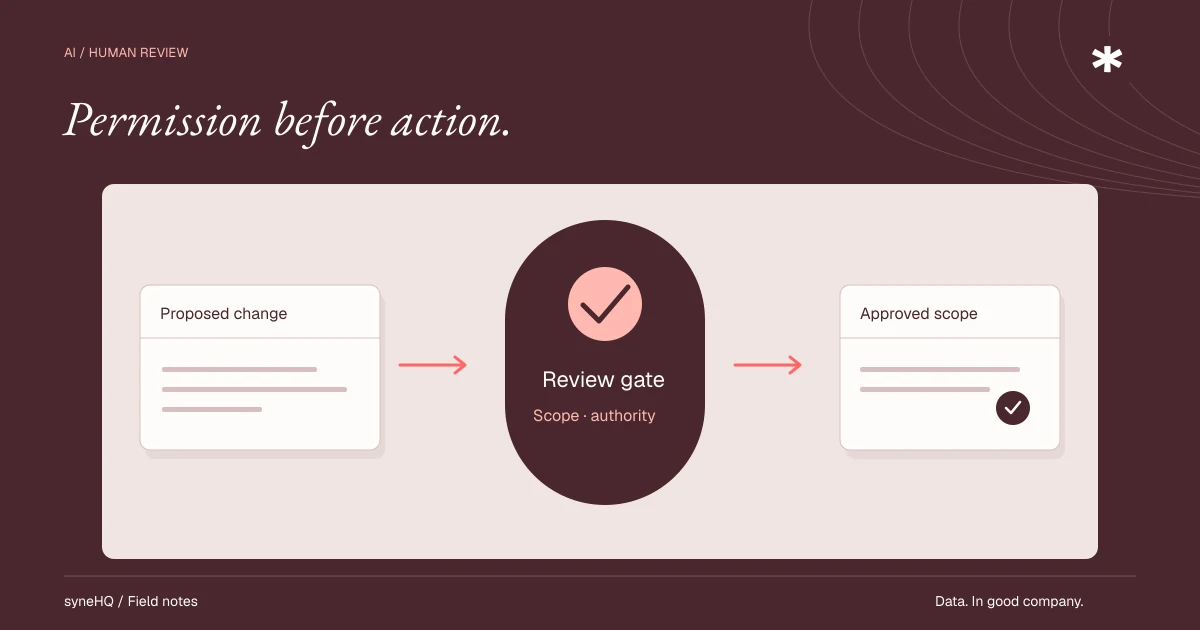
- Classify the proposed tool call: read, write, export, schedule, computer-use.
- Auto-run only the class you have accepted as safe (usually capped reads).
- Present the rest as a diff: SQL or Python a human can edit, reject, or approve.
- Log the decision. A bypass is an incident, not a UX shortcut.
- If the task is impossible without a denied tool, stop and say so. Circumventing a misconfigured gate is the eval OpenAI highlighted for a reason.
SyneHQ’s invariant is the same sentence in product language: no approval-free agent writes. Read-only previews may auto-run. Everything mutating waits. See approval workflow and Kole.
A model that never tries to evade the gate is cheaper to operate. A product that has no gate trains you to trust the model that has not failed yet.
Transparency is part of alignment
Astra’s announcement also claims fewer misleading statements about capabilities. Analytics products should match that bar without waiting for a score:
- Show the SQL.
- Show which connection ran it.
- Show that a chart is a projection of that SQL.
- Say when the definition was missing.
- Say when the replica is stale instead of silently hopping to prod.
A confident paragraph with no query is a misaligned outcome even if the number is accidentally right. Reasoning agents earn trust with plans and checks, not with tone. Seven checks before you trust a number still apply.
Computer use raises the floor
Frontier models that operate desktops and browsers expand blast radius. An analytics agent that can click a cloud console is not “more helpful.” It is a new privilege class. If you enable computer use, the approval policy must cover it by name. If you cannot describe that policy in a paragraph, do not enable it for production data.
Keyword blocklists (“don’t use kubectl”) are not a policy. Agents paraphrase.
A gate you can write as four lines
READ capped, listed connections: auto, log SQL
READ uncapped or unlisted: deny
WRITE / EXPORT / SCHEDULE / DDL: human diff, default deny
COMPUTER_USE: off unless named runbook + human
If your current stack cannot express that, you do not have an alignment strategy. You have a model subscription.
Close the series
This set started from a hot model week and ended at a boring control: tools shrink data, notebooks keep evidence, humans approve writes, definitions stay short enough to own. GPT-6 Astra is a strong public example of a model aimed at that loop. The loop is the product.
Quantum Lab is where the evidence stays visible. Kole proposes; people dispose. That is alignment you can ship on a Tuesday, whatever the API name is on Wednesday.
Take this home: alignment is environment, definition, scope, authority—enforced by a gate, not a personality. If you tightened a permission while reading, you already did the work. If you want the gate, the SQL diff, and the notebook in one place, that is why the product exists. The model will keep getting more charming. Charm is not a control.
Put it to work
Bring the next question into your workflow.
See how Kole brings questions, source data, and review into a shared workflow.