
Blog /
GPT-6 Sol, GPT-6 Luna, and Claude Opus 5.5: Which Tier Gets Which Analytics Task
SyneHQ
On this page
Three frontier-adjacent models shipped in the same week. OpenAI released GPT-6 Sol and GPT-6 Luna, two cheaper siblings of Astra. Anthropic released Claude Opus 5.5, priced below Opus 5 and pitched at agentic coding and knowledge work. Each launch page includes a chart in which its own model looks good.
None of that tells you which model should answer "what was net revenue last Tuesday?" and which should work out why it fell. That was the argument of our routing post: route by question shape and tool count, not by launch week. This post applies that rule to the new models and ends with a way to test a new model before it becomes your default.
What was actually announced
Everything in this section comes from vendor pages and one independent index. Benchmark numbers are vendor-reported unless labelled otherwise. SyneHQ has not measured any of them.
| GPT-6 Luna | GPT-6 Sol | Claude Opus 5.5 | |
|---|---|---|---|
| Vendor positioning | "Most efficient model for focused, high-volume tasks" (model page) | Built for complex coding and agentic workflows (model page) | For long-running agentic coding and knowledge work (models overview) |
| Input / output per 1M tokens | $0.10 / $0.50 | $2 / $10 | $4 / $20 |
| Cached input reads per 1M | $0.01 | $0.20 | $0.20 |
| Context / max output | 1,050,000 / 128,000 | 1,050,000 / 128,000 | 1M / 128K |
| Reasoning control | Effort from none to max, default medium |
Same | Adaptive thinking, always on, default effort medium |
A few details from the same pages matter for analytics work.
- Long prompts cost more on OpenAI. On both the Sol and Luna pages, prompts over 272K input tokens are billed at 2x the input rate and 1.5x the output rate for the whole request. The million-token window exists, but a pasted warehouse extract now pays a surcharge as well as adding distractors.
- Opus 5.5 always thinks. Anthropic's launch page says the model can no longer be run with thinking switched off. For a one-line lookup, that affects latency and output tokens. Measure both.
- OpenAI still recommends Astra when quality matters most. Its announcement calls Astra its best model across the board. Anthropic's models overview suggests Opus 5.5 for most workloads and Fable 5.1 when Opus 5.5 at higher effort still falls short. Neither vendor presents its mid-priced model as the ceiling.
- Anthropic's smaller 5.5 models are not out yet. The launch page says Sonnet 5.5 and Haiku 5.5 follow in the coming weeks. Until then, Anthropic's cheap tier is the previous generation.
Reading the benchmarks without picking a winner
Both vendors published results on the same benchmark names. The figures still don't compare directly.
On AutomationBench, OpenAI reports Sol at xhigh effort scoring 33.2% at $0.27 per task, ahead of Claude Opus 5 at max effort (OpenAI). OpenAI compared against Opus 5, not Opus 5.5. Anthropic's table lists Opus 5.5 at 40.0% and GPT-6 Astra at 41.4%, from runs Zapier performed and reported (Anthropic). The two tables use different effort settings, different runs, and different comparison models.
Anthropic also reports Opus 5.5 at 66.4% on Terminal-Bench 4.0 against 57.9% for Astra. On Terminal-Bench-Science it reports 58.7% for Opus 5.5 against 64.6% for Astra. Each model leads on one of those two tests. Anthropic's own page says benchmark margins have become a less reliable guide to real-world differences at this capability level. We agree.
The independent view from Artificial Analysis is useful on cost. At max effort with fallback, Opus 5.5 ranks first on its Intelligence Index (58) at the time of writing. It costs $5.98 per index task and generated 260M output tokens during the run, against a median of 88M. On the same page, GPT-6 Luna at max effort scores 37 at $0.07 per task. Anthropic reports that Opus 5.5 uses fewer tokens per task than Opus 5. Both statements can be true, because output tokens depend heavily on the effort setting. Measure tokens at the effort level you will actually run.
One customer note on the Anthropic page is directly about analytics. Hex describes a DataBench task in which Opus 5 accepted a plausible explanation and Opus 5.5 "keeps digging past the first plausible answer." That is the right failure mode to test. It is also one customer's report, and it compares Opus 5.5 with its predecessor, not with Sol.
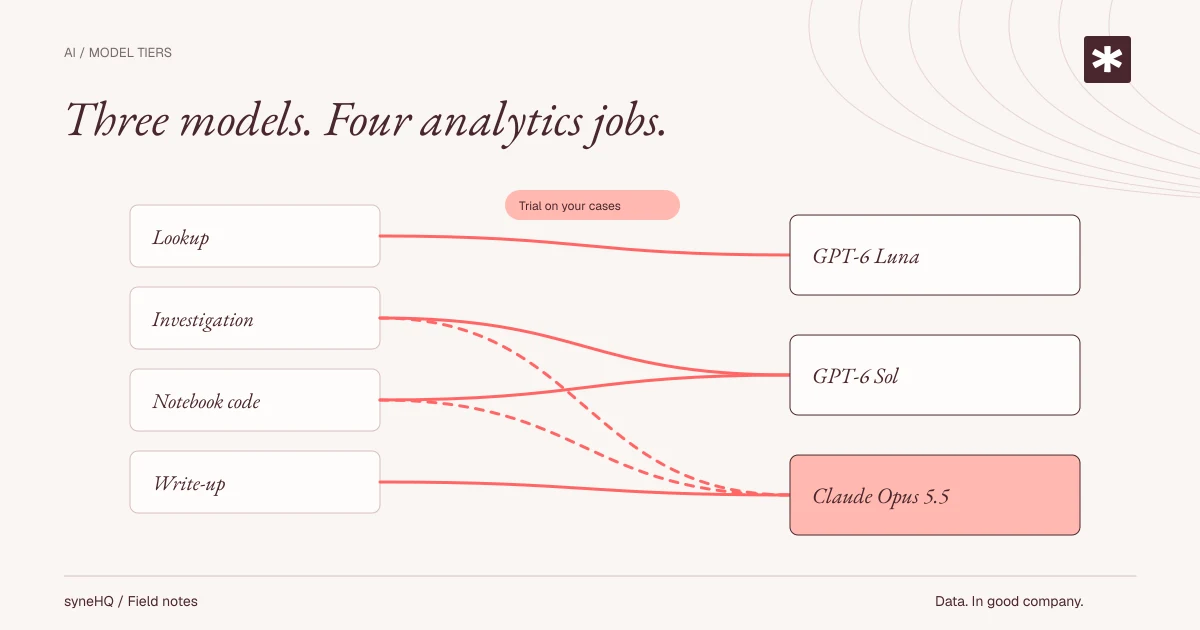
Which tier to trial first, by task
The four jobs an analytics agent does have different costs when they go wrong. A wrong lookup is usually caught against a dashboard. A bad investigation can end up in a board deck. Match the tier to the damage a mistake can do.
| Task type | What matters | Tier to trial first | What to measure |
|---|---|---|---|
Lookup: named metric, known grain, one SELECT |
Correct definition, asks when the name is ambiguous, low latency | Luna at low or none effort; keep the current small Claude model as the baseline until Haiku 5.5 ships |
Result exact-match against signed SQL; rate of guessed definitions; p95 latency |
| Investigation: variance, join choices, hypotheses that failed | Keeps looking after the first plausible cause; every claim backed by a query | Sol at high or xhigh and Opus 5.5 at its default medium, head to head; escalate to Astra or Fable only on the cases both fail | Supported-claim rate; tool rounds; cost per accepted case, not per call |
| Code / Python in a notebook | Cells run, diffs stay small, no silent reshaping of the data | Sol and Opus 5.5; both vendors lead with coding claims | Execution pass rate; reruns to green; rows changed outside the intended step |
| Final write-up for a stakeholder | Every figure traces to a cell; caveats survive editing | Whichever investigation model won, at lower effort, given the finished notebook | Figures without a source cell (target: zero); reviewer edits per memo |
The same pattern holds on every row. Cheap models handle work that has a single right answer and a mechanical check. Expensive models handle work where the check is whether the evidence supports the conclusion. Writes, schedules, and DDL are not a model-choice question at all. They go to a person.
Hypothetical cost math
These numbers are illustrative, not measured. Suppose 200 lookups a day, each with 6,000 input tokens (catalog snippet plus question) and 500 output tokens, at uncached list rates:
- Luna: 1.2M input ≈ $0.12, 100K output ≈ $0.05. About $0.17/day.
- Sol: ≈ $2.40 + $1.00. About $3.40/day.
- Opus 5.5: ≈ $4.80 + $2.00. About $6.80/day.
Reasoning tokens are billed as output, so higher effort raises the output line. Caching lowers the input line. The gap in this sketch is a factor of 40, and it only pays off if Luna gets the lookups right. The bake-off below exists to check that. The wider argument about whether tokens are getting too cheap to meter is for another post.
Run your own bake-off before you switch
A launch week is a bad time to change a default and a good time to run your evaluation set. Here is the minimum version.
- Fix the case set. Take 40 to 100 real questions from your logs, split across the four task types in the table. Freeze them with the schema snapshot, the approved metric definitions, and the expected SQL or the list of acceptable conclusions. Include cases where the right answer is to ask a clarifying question.
- Hold the harness constant. Use the same tools, row caps, system prompt, and iteration limit for every model. Change only the model and the effort setting. If one model gets a better prompt, you are measuring the prompt.
- Run each case more than once. Three runs per case at your production effort setting will show variance that a single run hides. Record resolved model IDs (
gpt-6-sol,gpt-6-luna,claude-opus-5-5) and dates. - Grade on evidence, not prose. Execute the SQL. Compare results against fixtures. For investigations, check each causal claim against the query that supports it. Our Jev evaluation post covers splitting mechanical checks from judged ones.
- Score cost per accepted answer. Add input, cached input, output, and reasoning tokens, then divide by the cases that passed review. A cheap model that fails half the investigations can cost more than an expensive model that passes them.
- Decide per row, not per vendor. One outcome might be Luna for lookups and Opus 5.5 for investigations. Another might be Sol for everything below Astra. The table above is where to start testing, not a conclusion.
Keep the traces. When Sonnet 5.5 and Haiku 5.5 ship, you rerun the same set and the comparison takes an afternoon.
Where Kole fits
Kole builds its analysis inside Quantum Lab: SQL, Python, tables, and charts stay visible, and configured consequential actions pause for approval. That doesn't choose a model for you. It does give a bake-off something to grade, because each accepted answer comes with the query and cells behind it, and you can check whether a more expensive model's extra reasoning changed the SQL or only the paragraph around it.
Before this week's launches change your defaults, run your own cases through the same harness and compare the results.
Put it to work
Bring the next question into your workflow.
See how Kole brings questions, source data, and review into a shared workflow.