
Blog /
From an Analytics Agent Pilot to a Weekly Team Workflow
SyneHQ
On this page
A team tests an analytics agent with a question whose answer everyone already knows. The query works, the chart looks right, and the demo ends well.
The following Monday, someone asks a slightly different question. Refunds arrived late, one region changed its reporting currency, and the analyst who understood the pilot is on leave. The team now needs a workflow that can handle uncertainty, review, and handoff.
The public overview of LangChain's Agentic Operating Model frames production agents around people, process, technology, and ongoing evaluation. This article applies that broad idea to a small analytics team. The example is a proposed rollout for a weekly revenue review, not a customer case study.
Choose a recurring decision
“Let people ask anything” is difficult to evaluate. A recurring question gives the pilot a useful boundary and repeated opportunities to improve.
For example: each Monday, explain the previous week's net-revenue movement by region, identify unresolved data issues, and prepare a notebook for the finance lead to review.
Write the acceptance conditions before choosing the model:
- Use the agreed revenue definition, currency treatment, and reporting timezone.
- Show the query and the comparison periods.
- Separate observed changes from explanations that still need evidence.
- Preserve unresolved questions when the available data cannot answer them.
- Leave proposed corrections for the existing review process.
This creates a deliverable a person can accept or reject. “The agent produced an answer” is only evidence that the interface responded.
Assign three responsibilities
A small team does not need three new job titles. It does need clear ownership for three different decisions.
| Responsibility | Owns | Example in the weekly review |
|---|---|---|
| Business owner | Definition, relevance, and acceptance | Finance lead decides whether the analysis answers the review question |
| Workflow owner | Connections, tools, execution controls, and recovery | Engineer maintains the permitted analysis path and investigates failures |
| Reviewer | Checks the evidence and approves consequential proposals | Analyst inspects the query, exceptions, and proposed next steps |
One person may cover more than one role. State that explicitly so “someone reviewed it” does not become the handoff policy.
Give the reviewer permission to stop a run or reject an output. Also define where a definition dispute goes. An agent cannot settle whether refunds belong to the sale period or the refund period by sounding more certain.
Build examples that can expose a wrong answer
Collect representative questions from the existing review process. Preserve the difficult ones: late refunds, customers without orders, duplicate joins, empty periods, and date boundaries.
For each example, record the expected result or acceptable behavior. Some cases should produce a number. Others should produce a clarification, a refusal, or an explicit statement that the evidence is incomplete.
Test multiple data fixtures for the same question. A query can accidentally return the correct total on one dataset while using the wrong filter or join. A fixture containing pending orders, NULL keys, or a period with no rows helps reveal that error.
Syne's SQL evaluation kit is a small starting point for this part of the work. It contains five tasks with three synthetic fixtures each, checking details such as paid-order filtering, missing customers, and half-open monthly boundaries. Its self-test checks the harness; it does not evaluate a model or establish production reliability.
Your complete workflow needs additional checks for definition selection, tool permissions, approval handling, and the written explanation. Keep a held-out set for decisions about releases, and add new regression cases as real failures appear.
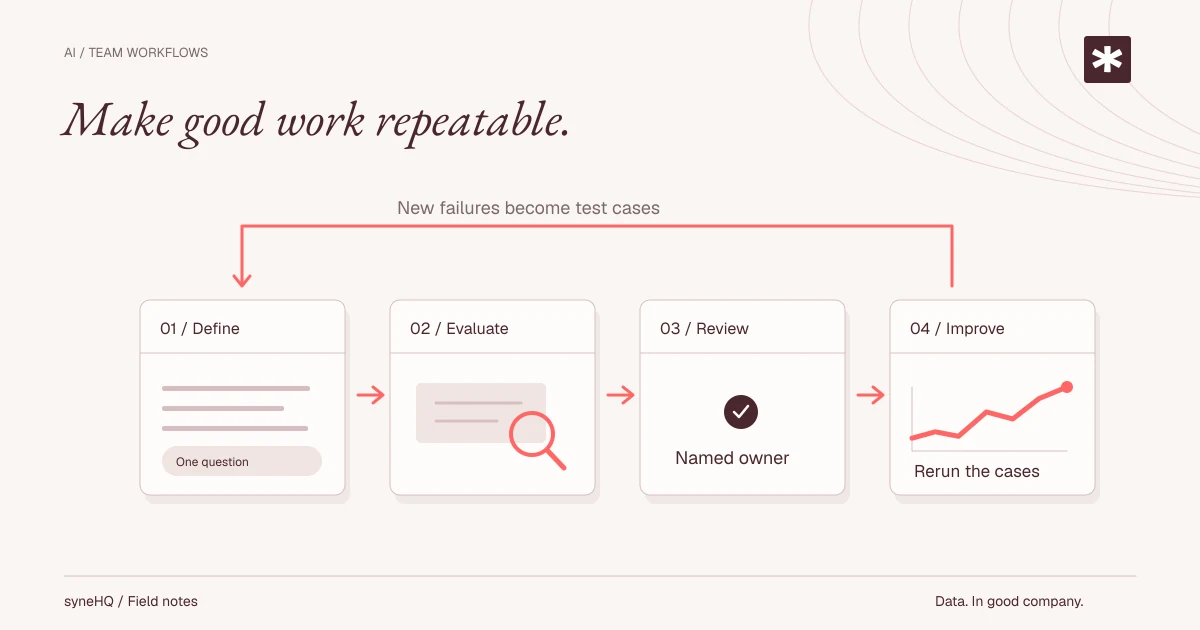
Move through four rollout gates
Use evidence to decide when to advance. A calendar date is useful for planning, but it is not an acceptance criterion.
1. Reproduce known work
Run against synthetic or controlled data and compare with reviewed answers. Verify query behavior and expected failures. Make the connection, definition, code, and execution status visible in the artifact.
Advance when the agreed cases pass and the team can explain the remaining limitations. Any permission-boundary failure blocks expansion, even if the average SQL score is high.
2. Observe alongside the existing process
Run the agent on the same weekly question as the current analyst workflow. Treat its output as a candidate for review. Record every initiated run, including failures, abandoned sessions, and outputs that required substantial rewriting.
Classify the disagreement before changing the system. A missing metric definition needs different work from a bad join, an unavailable connection, or an unsupported causal claim.
3. Use it with named reviewers
Let a small group use the agent for the bounded workflow. Keep a clear fallback to the existing analysis process. Reviewers should know which outputs need validation and which proposed actions require explicit approval.
Advance when the group can complete and review the work consistently, handle failures, and reconstruct a result without the original pilot author present.
4. Expand one dimension
Add a new question type, dataset, audience, or action class one at a time. A workflow validated for regional revenue comparisons has not automatically been validated for customer exports or order corrections.
Each expansion should add representative examples and an owner. If quality falls, return that part of the workflow to its previous operating mode while preserving the useful parts.
Measure accepted work and review effort
Start with a small scorecard. Define the denominator and retain the underlying examples.
| Measure | What to count |
|---|---|
| Acceptance rate | Accepted outputs divided by all initiated in-scope runs, with failed and abandoned runs visible |
| First-attempt correctness | Correct outputs before retries, edits, or reviewer repairs |
| Time to accepted analysis | Elapsed time from the request to reviewer acceptance |
| Review effort | Minutes spent checking and correcting the result |
| Completed-work cost | Model and execution charges, including unsuccessful attempts |
| Boundary failures | Unauthorized attempts and executions, reported separately |
Compare against a documented baseline for the same task mix. Ten easy questions and one hard investigation should not be presented as eleven equivalent successes. Report the sample size and avoid broad claims from a small pilot.
Review effort matters because an agent can produce more work while creating a larger verification burden. A shorter generation time is useful only if the team still reaches an accepted result efficiently.
Turn a failure into a regression case
Suppose the agent omits customers who had no orders during the comparison period. Preserve the request, relevant schema, query, and a minimal sanitized fixture that exposes the omission.
Then decide where the correction belongs. It may require a clearer metric definition, a better tool response, a changed prompt, or an application fix. Repeating “be careful with joins” in every future conversation is hard to maintain.
Rerun the affected case and the representative evaluation set. Record the model, prompt, tool, and definition versions involved. A model upgrade can change behavior even when the application code is unchanged.
In Quantum Lab, the notebook keeps SQL, Python, outputs, and written context together. Saved queries can turn a settled calculation into a reusable starting point. Kole can help with the investigation around it, while the team's review process determines whether the result is ready to use.
The pilot has become a team workflow when someone other than its author can run it, review it, recover from a failure, and explain how the accepted answer was reached.
Put it to work
Bring the next question into your workflow.
See how Kole brings questions, source data, and review into a shared workflow.