
Blog /
Governing Analytics Agents: A Practical Guide for Small Teams
SyneHQ
On this page
An operations team asks an agent to investigate a rise in refunds. It finds the right table, produces a useful chart, and suggests updating several order records. Then someone asks three questions: which database did it use, who can approve those updates, and how much did the investigation cost?
Those questions should have answers before the first run.
LangChain's guide to building governed agents describes governance across model calls, tools, providers, and teams. For an analytics team, the practical starting point is a single investigation with explicit boundaries. This guide turns that idea into a policy you can review, implement, and test.
The examples below are proposed operating practices. Check each control against your deployment rather than assuming a product setting implements the whole policy.
Start with an investigation brief
“Help with refunds” leaves too much open. It could mean producing a report, fixing records, contacting customers, or changing how the business recognizes revenue.
Write a short brief that identifies the question, the data boundary, the deliverable, and the person responsible for accepting it.
| Field | Illustrative refund investigation |
|---|---|
| Question | What explains the increase in the refund rate last week? |
| Definition | Refunded settled orders divided by settled orders, using the team's agreed refund window |
| Data | Orders and refunds on the approved reporting connection |
| Output | A notebook with queries, segment comparisons, and unresolved questions |
| Owner | The operations lead accepts or rejects the findings |
| Allowed follow-up | Propose a correction for review |
| Separate authorization | Updating orders, exporting customer details, or contacting customers |
The brief prevents an ambiguous request from quietly becoming a broader assignment. It also gives the reviewer something concrete to compare with the finished work.
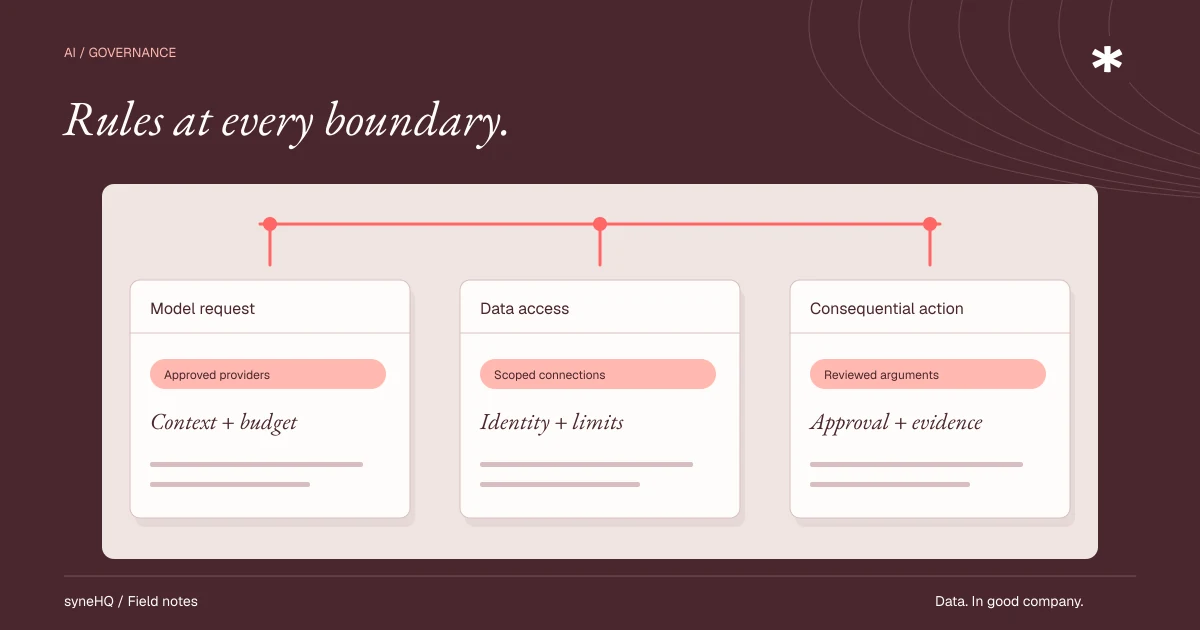
Enforce controls at the boundary they protect
A model gateway can restrict providers and record token usage. It cannot, by itself, establish that a SQL tool selected the right workspace or that a notebook export reached an approved recipient.
Map each rule to the component that can enforce it:
| Boundary | What to enforce | Evidence to retain |
|---|---|---|
| Model request | Approved provider and model, permitted context, request budget | Resolved model, usage, policy version |
| Database call | Authenticated identity, accessible connection, read restrictions, query limits | Connection, SQL or protected query reference, outcome |
| Python execution | Workspace isolation, resource limits, approved data and network access | Runtime version, inputs, outputs, failure status |
| Consequential action | Current permission and review of the actual operation | Approved arguments, reviewer, execution result |
| Sharing | Authorized audience and permitted output fields | Destination, artifact version, sharing decision |
These are separate checks. Permission to read an order table does not automatically include permission to send its contents to another service. Approval to update one record does not authorize a later, broader filter.
Resolve identity from the authenticated application session. Treat team names, connection IDs, and claimed approvals inside model-generated arguments as inputs to validate, never as proof of authority.
Budget the investigation, not just the model call
Analytics work consumes model tokens, database time, Python memory, and a reviewer's attention. Optimizing one bill can increase another. Returning a million rows to save a second warehouse query may create a much more expensive Python session.
Start with limits that match the workload. The following is an illustrative policy brief, not a Syne configuration file:
Workload: refund investigation
Connections: approved reporting connection only
Tool rounds: up to 8 before a progress checkpoint
Query execution: read-only, with a server-enforced timeout
Model context: aggregates and necessary masked samples
Python: bounded memory and execution time
Writes and outbound sharing: explicit review
On budget exhaustion: preserve partial work and report the gap
Choose actual values after inspecting representative runs. A result-row cap controls the response size; it does not cap warehouse scans or the cost of a large join. Use database-side timeouts and workload controls as well.
Record cost per accepted investigation, including retries and failed attempts. Keep model charges, warehouse charges, runtime charges, and review time separate when their units differ. Missing measurements should stay visible rather than disappearing into a reassuring total.
Make approval specific enough to mean something
A card saying “Approve the agent” does not describe the operation a person is accepting.
For an order correction, show the target connection, proposed SQL, intended scope, and reason. Where feasible, provide a bounded preview of affected records. Explain that a preview reflects a point in time; it does not guarantee the database will remain unchanged before execution.
After approval, revalidate permissions and execute only the reviewed operation. If arguments change materially, return to review. If the operation requires a transaction or a precondition, enforce that in the database workflow.
There is also a difference between rejecting a proposal and reporting that execution failed. Preserve both states. An approved operation that times out is not evidence that nothing happened; reconcile its status before retrying, especially when the action can have external side effects.
In Syne, the approval workflow lets a person inspect and edit configured consequential agent proposals. The broader policy still depends on the permissions, database configuration, and operational procedures around that interaction.
Decide how failures behave
Failure handling is part of the policy. Write it down for the boundaries that matter:
- Provider unavailable: use a backup only if it meets the same data-handling policy and has been evaluated for the workload. Otherwise, report the interruption.
- Connection denied: stop that operation. An agent should not search for a more privileged connection to complete the same query.
- Definition missing: ask for the business definition or name the limitation. Do not silently substitute gross sales for net revenue.
- Approval rejected: return the rejection and feedback to the agent. A revised proposal must be reviewed on its own merits.
- Required evidence cannot be recorded: stop consequential work when recording that evidence is a policy requirement.
A cheaper fallback model is a routing choice. A fallback that changes where private data is processed is also a policy change. Treat both aspects explicitly.
Test the policy before widening access
Use a small set of synthetic cases that challenge the boundaries, not just the successful analysis. Include a cross-team connection request, a read query that times out, a proposed write, an edited approval, and an unavailable provider.
For each case, record the expected decision and the observed result. A refusal in the chat transcript is not enough if the tool still executed. Inspect the execution record.
Then run a reconstruction check: can a teammate identify the question, source, definition, queries, review decision, and final result from the retained artifacts? Apply access and retention rules to those artifacts too. Audit records can contain sensitive query text and parameters.
Quantum Lab provides a place to keep SQL, Python, charts, and explanations together. Team scoping and audit trails address other parts of the workflow. Assess those capabilities together against the policy you wrote.
The first useful governance deliverable is a bounded investigation that another person can approve, inspect, and reproduce. Once that works, expand the question set or the audience one step at a time.
Put it to work
Bring the next question into your workflow.
See how Kole brings questions, source data, and review into a shared workflow.